Most homeowners hear about Orangeburg pipe in one of two ways: a line item on a home sale inspection report, or a backup that keeps coming back no matter how many times it gets snaked. Either way, the problem is buried under the lawn, which is what makes it hard to assess.
Delaware County has thousands of mid-century houses, and many of them still drain through the lateral that was installed when they were built. If your home went up between the 1940s and 1970s, that lateral may not be clay or cast iron at all. It could be pressed wood pulp and tar.
What Is Orangeburg Pipe and Why Does It Fail?
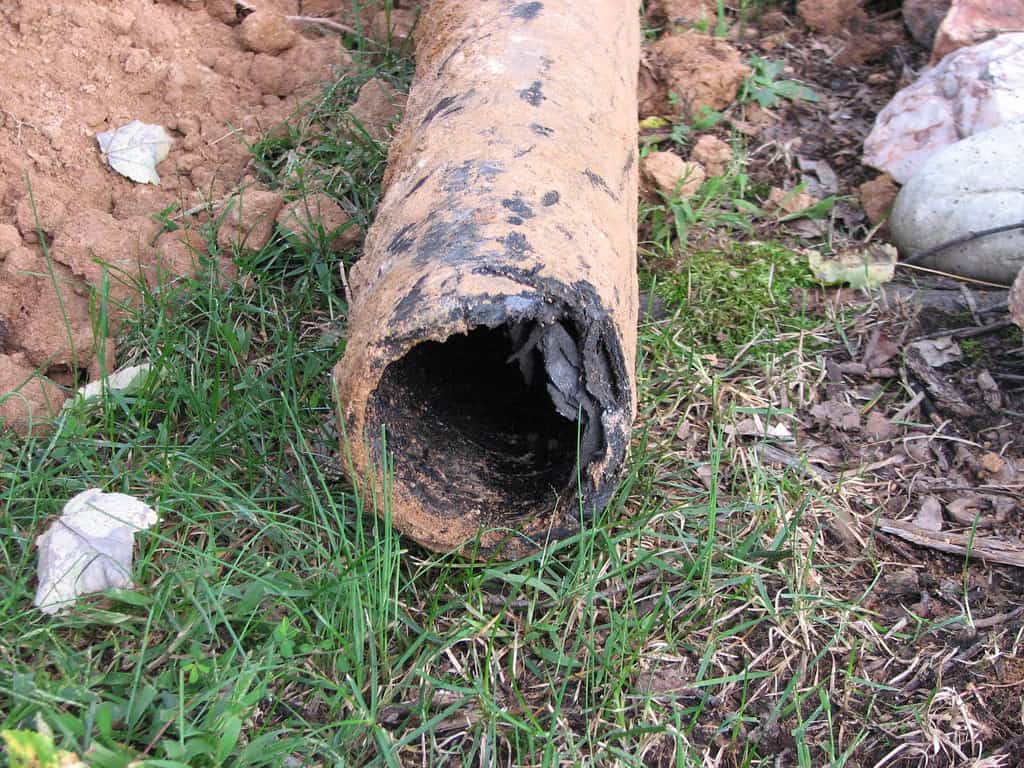
Orangeburg pipe is made from layers of wood pulp fibers pressed together with coal tar pitch between each wrap, and a single 4-inch pipe can contain as many as 25 layers. The name comes from Orangeburg, New York, where most of it was manufactured. During the building boom after World War II, builders needed drainage material that was fast to install and easy to get, and bituminized fiber was both: lightweight enough for one person to carry a length of it, and simple to cut on site.
What it never had was structural strength. Clay and cast iron carry the weight of the soil above them for generations. A fiber conduit relies on pressed cellulose held together by pitch, and both of those absorb water. As moisture from the surrounding soil and from the wastewater inside works into the walls, the binder softens, and the pipe begins to lose its shape.
When Was Orangeburg Pipe Used?
Industry reporting puts the period when contractors connected homes to public sewer mains with this material at roughly 1940 to 1970, and the Orangeburg, New York plant closed in the fall of 1972. The same reporting gives the pipe a useful life of up to 50 years, with deformation typically starting after about 30.
Both numbers matter for a house in this area. Even the newest original installation is now past 50 years old, which means every one of these lines is operating beyond the outside end of its expected life, not just past the point where deformation begins. Ground pressure has been working on a softened pipe for decades.
How Bituminized Fiber Pipes Break Down
Failure happens in stages rather than all at once:
- Softening and moisture absorption: Constant exposure to wet earth and warm wastewater softens the tar binder.
- Ovalization and flattening: The round pipe flattens under the weight of the soil above it.
- Delamination: Internal layers peel away like wet cardboard, creating ridges that catch solid waste.
- Root intrusion: Tree roots push through the softened walls toward the water inside and form dense root balls.
- Structural collapse: The flattened walls buckle, and wastewater can no longer leave the house.
Once the inner layers start delaminating, waste and paper snag on the rough edges, which is why clogs in these lines come back within weeks of being cleared.
That repeat-clog pattern creates a second problem. A mechanical drain snake with a steel cutting head spinning inside a softened fiber line can punch straight through the wall. A routine clog becomes a torn lateral, and the homeowner has gone from a drain problem to an excavation.
How to Identify Orangeburg Pipe and Warning Signs of Failure
A failing Orangeburg sewer line usually gives months of warning before it stops draining altogether. Homeowners in Havertown and the surrounding Delaware County communities should watch for changes in how the house drains as a whole, not just at one fixture.
- Slow drains throughout the home: Sinks, showers, and tubs draining sluggishly at the same time on different floors.
- Frequent backups: Drains that clog again shortly after being cleared.
- Gurgling fixtures: Toilets bubbling or making a sucking noise when the washing machine drains.
- Sewer gas odors: Smells drifting through the basement, bathroom vents, or the yard.
- Lush patches or sinkholes: Grass that is unusually green along one line, or soil that dips on the path toward the street.
The pattern is what tells you where the problem is. When several fixtures act up at once, the trouble is in the main lateral rather than a branch line.
Confirming Your Sewer Pipe Material
The year the house was built is a starting point, not an answer. Previous owners may have replaced a section, and builders sometimes used clay or cast iron on particular lots regardless of what was going in next door.
A sewer camera inspection is how you find out. A technician feeds a waterproof camera through the cleanout and watches a live feed on a monitor, reading the pipe’s shape, its joints, and the material itself. The camera shows whether the conduit has gone oval, blistered on the inside, or taken on roots, and it answers the question without anyone digging up the yard.
Can Orangeburg Pipe Be Saved?
Homeowners often ask about Orangeburg pipe repair after a few slow drains. The honest answer is that bituminized fiber cannot be patched or relined once it has started to deform, and several standard clearing methods accelerate the collapse.
High-pressure hydro jetting is effective on grease in metal or plastic pipe. Inside an old fiber conduit, the same pressure strips the softened pitch and lifts the paper layers apart. Chemical root killers and mechanical cutting heads carry similar risks. Once the lateral has lost its round shape, replacement is the durable answer.
Modern Replacement Materials: PVC and HDPE
Replacement lines are installed in materials built to hold up under decades of soil load:
- Polyvinyl Chloride (PVC): For buried sewer laterals, SDR 35 PVC is the common specification, with Schedule 40 used where a heavier wall is called for. Both give you a rigid pipe with smooth interior walls that resist the grease and paper buildup a delaminated fiber line collects, and solvent-welded joints that leave roots very little to work with.
- High-Density Polyethylene (HDPE): HDPE arrives as a flexible pipe joined by heat fusion. Because a fused joint is as strong as the pipe body, there are effectively no joint gaps along the run. It tolerates ground movement and heavy external load without cracking.
Both materials outlast bituminous fiber by a wide margin, which is the whole point of the replacement.
Comparing Replacement Methods: Excavation vs. Trenchless
There are two ways to get a new line in the ground, and the right one depends on the condition of the old pipe and what sits above it.
Traditional Open-Trench Excavation
An excavation crew opens a continuous trench along the sewer path, lifts out the degraded pipe, and beds new PVC on fresh gravel.
- Advantages: Open excavation works in any condition, including a line that has pancaked completely. It also lets the plumber correct the slope, take out low spots, and remove bellies where water has been standing.
- Trade-offs: The disruption is real. A backhoe going down the line tears up grass, garden beds, walkways, or driveway, and putting the landscaping and hardscaping back is its own project after the plumbing is finished.
Trenchless Sewer Line Replacement
A trenchless method such as pipe bursting installs the new line with far less surface disturbance. The crew digs a small entry and exit pit, then a bursting head pulls seamless HDPE through the existing lateral, fracturing the brittle fiber outward into the surrounding soil.
- Advantages: Your yard, porch, and driveway stay largely intact. With no full trench to open and backfill, the work finishes faster, and the cleanup is minor.
- Trade-offs: The bursting head and cable need a continuous path through the old pipe. If the lateral has collapsed entirely, the equipment has nothing to follow. Trenchless also cannot correct a bad slope or reverse a grading problem, since the new pipe follows the path the old one took.
A sewer line replacement plan weighs those factors against what the camera actually found. The video inspection is what determines whether the lateral has held enough shape for trenchless or whether the job calls for digging.
Taking the Next Step for Your Home’s Sewer Line
Learning that your house drains through vintage bituminized fiber is unwelcome news, but finding out before the line gives way is the good version of this problem.
Every Orangeburg lateral still in service is past the outside end of its expected life. Waiting until one caves in turns a planned project into an emergency, and it removes your ability to choose how the work gets done. Finding out now means you can weigh excavation against trenchless, schedule around your own calendar, and know the depth, path, and condition of the line before anyone quotes the job.
Upgrading to PVC or HDPE gives you a lateral that should outlast your time in the house.
Schedule a Professional Sewer Inspection With Adam Home Services
If your drains keep backing up or an inspection report flagged fiber conduit pipe, our team can tell you what is actually down there. Adam Home Services provides clear diagnostic evaluations and lasting sewer solutions for homeowners throughout Havertown and Delaware County, with upfront pricing, 24/7 live answering, and same-day service. Contact our team today to schedule your sewer camera evaluation.
Sources
PHCP Pros, “Everything You Wanted to Know About Orangeburg Pipe But Were Afraid to Ask”: https://www.phcppros.com/articles/17134-everything-you-wanted-to-know-about-orangeburg-pipe-but-were-afraid-to-ask