
A slow drain in one sink is usually hair or soap buildup. You clear the trap, flush the line, and it drains again. The question worth asking is whether that sluggish flow stays in one spot or shows up across the house.
When several drains back up at once, or running one fixture makes another gurgle, the problem has moved past the branch pipe. Every drain in the house empties into a single underground lateral that carries waste out to the township main. Catching sewer line problems at that stage gives you time to fix them before wastewater reaches your basement floor.
5 Warning Signs of Main Sewer Line Failure
Lateral failures follow a fairly predictable progression. Drainage slows first, and sewage entering the house comes last. These are in that order.
1. Multiple Fixtures Draining Slowly at Once
- What you notice: The kitchen sink, the powder room toilet, and the upstairs tub all drain slowly at the same time.
- What is happening underground: A partial restriction is forming inside the main lateral. Because every fixture empties into that one pipe, waste collects behind the restriction. This is the symptom that separates a main line problem from an isolated clog.
- Urgency: Moderate. Water still moves, but the line needs attention before it closes off.
2. A Gurgling Toilet or Shifting Water Level
- What you notice: The toilet bubbles, gurgles, or loses its water seal when the washing machine drains or a tub empties.
- What is happening underground: Trapped air cannot vent through the roof stack, so it pushes back through the path of least resistance, which is often the water trap in the toilet bowl.
- Urgency: Moderate to high. Air bubbles mean the blockage covers most of the pipe diameter.
3. A Persistent Sewer Smell Inside or Near the Cleanout
- What you notice: Sewer gas in the basement, the laundry area, or around an outdoor cleanout cap.
- What is happening underground: Cracked pipe walls, shifted joints, or dry traps are letting gas escape. In a sound system, that gas vents through the roof stack.
- Urgency: High. Odors point to a broken seal or a venting failure, and both call for a camera check.
4. A Soggy, Sunken, or Unusually Green Patch of Lawn
- What you notice: A section of yard above the lateral stays damp in dry weather, or the grass there grows noticeably greener.
- What is happening underground: Liquid waste is escaping into the soil. Wastewater fertilizes the grass above it, and the constant moisture washes out supporting soil, which is what produces the sunken spot.
- Urgency: High. That pattern means an active crack or a separated joint.
5. Sewage Backing Up Into Basement Drains
- What you notice: Dark water and residue coming up through basement floor drains, utility sinks, or lower showers after a toilet is flushed.
- What is happening underground: The lateral is severely or completely blocked. Wastewater cannot reach the street main, so it exits through the lowest openings in the house.
- Urgency: Emergency. Stop running water anywhere in the house immediately.
Why Older Delaware County Homes See These Problems
A lot of Havertown was built between 1920 and 1960, and those homes still run on the underground infrastructure they were built with. Decades of soil movement and material wear are what make these failures common here.
Tree Roots in the Joints
Properties around here have mature oak, maple, and sycamore, and roots follow water and nitrogen. Original vitrified clay and cast iron laterals were laid in short sections, sealed at the joints with mortar or oakum packing. Fifty or sixty years of ground movement cracks those seams. Fine root hairs find the opening, expand into a mass inside the pipe, and start catching solids.
Bellied Sections from Settling Soil
Local clay soil swells in wet springs and shrinks through dry summers. Decades of that movement let sections of pipe sag, creating a belly that holds standing water. Solids lose velocity in the pool and settle, which is what turns into a recurring clog.
Slope is what prevents this when the line is sound. The International Plumbing Code, which Pennsylvania follows, sets minimum drainage slope by pipe size in Table 704.1. A typical residential lateral of 3 to 6 inches requires at least one-eighth inch of fall per foot, while smaller fixture drains of two and a half inches or less require one-quarter inch per foot. Once a belly forms, the line has lost the grade it was installed with.
Corrosion and Material Failure
Cast iron rusts and scales along the bottom of the pipe after several decades, leaving a rough surface that catches paper and grease. Vitrified clay does not rust, but it is brittle, and ground pressure or driveway traffic can crack it. At the end of its service life, clay pipe can collapse without much warning.
Why a Camera Inspection Comes Before Any Repair
Guessing at the cause of a backup is how you end up clearing the same line twice. Root intrusion, grease buildup, a bellied section, and a cracked joint all produce the same gurgling fixtures, and each one calls for a different fix.
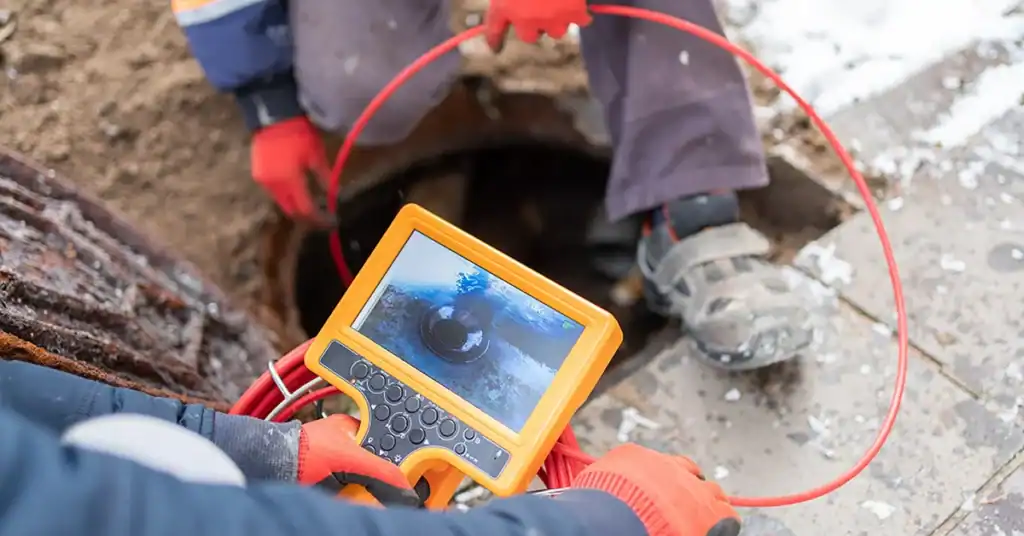
During a sewer camera inspection, a technician feeds a high-definition camera into the cleanout and runs it out toward the street connection, watching a live feed the whole way.
That tells us:
- The exact location and depth of the fault.
- The pipe material and its interior condition.
- Whether hydro jetting will clear the line.
- Whether the line needs structural repair, trenchless lining, or excavation.
Both the diagnostic and the repair methods have limits worth knowing. A camera needs an accessible cleanout and a line clear enough to see through. If the lateral is full of standing waste, the lens cannot read the pipe walls until we snake it enough to restore some flow.
Trenchless lining has its own boundary. It repairs a damaged pipe without opening up a lawn or driveway, but it cannot correct a bellied line or rebuild a collapsed one, because the liner takes the shape of whatever it is installed inside. When a line has lost its pitch or the walls have crushed, open-trench excavation is the only thing that restores proper gravity flow.
Catching It Early
Bubbling toilets, slow floor drains, and sewer odors are the line telling you it is struggling. Ignoring them is how raw sewage ends up in a finished basement.
If your drains are showing any of these signs, a camera evaluation will identify what is actually happening so you can decide on the right repair for your wastewater system.
Schedule Sewer Line Service
Adam Home Services has handled lateral problems across Delaware, Chester, and Montgomery counties since 2002. Our licensed technicians offer same-day service, upfront pricing, and 24/7 live answering.
If you suspect a problem, do not wait for a full backup. Get in touch to book a camera inspection. See our plumbing services or check our service area for coverage.